The Lithium Question
We get asked about lithium battery upgrades constantly. Owners hear about the weight savings, the longer cycle life, and the faster charging, and they want to know if it's worth the investment. The short answer is: for most boats, yes. But the longer answer involves understanding what you're actually getting, what it costs, and the compliance details that matter on the water.
Let's walk through the real-world differences between AGM and lithium, the costs involved, and the ABYC compliance requirements that most installers gloss over.
Weight Savings That Actually Matter
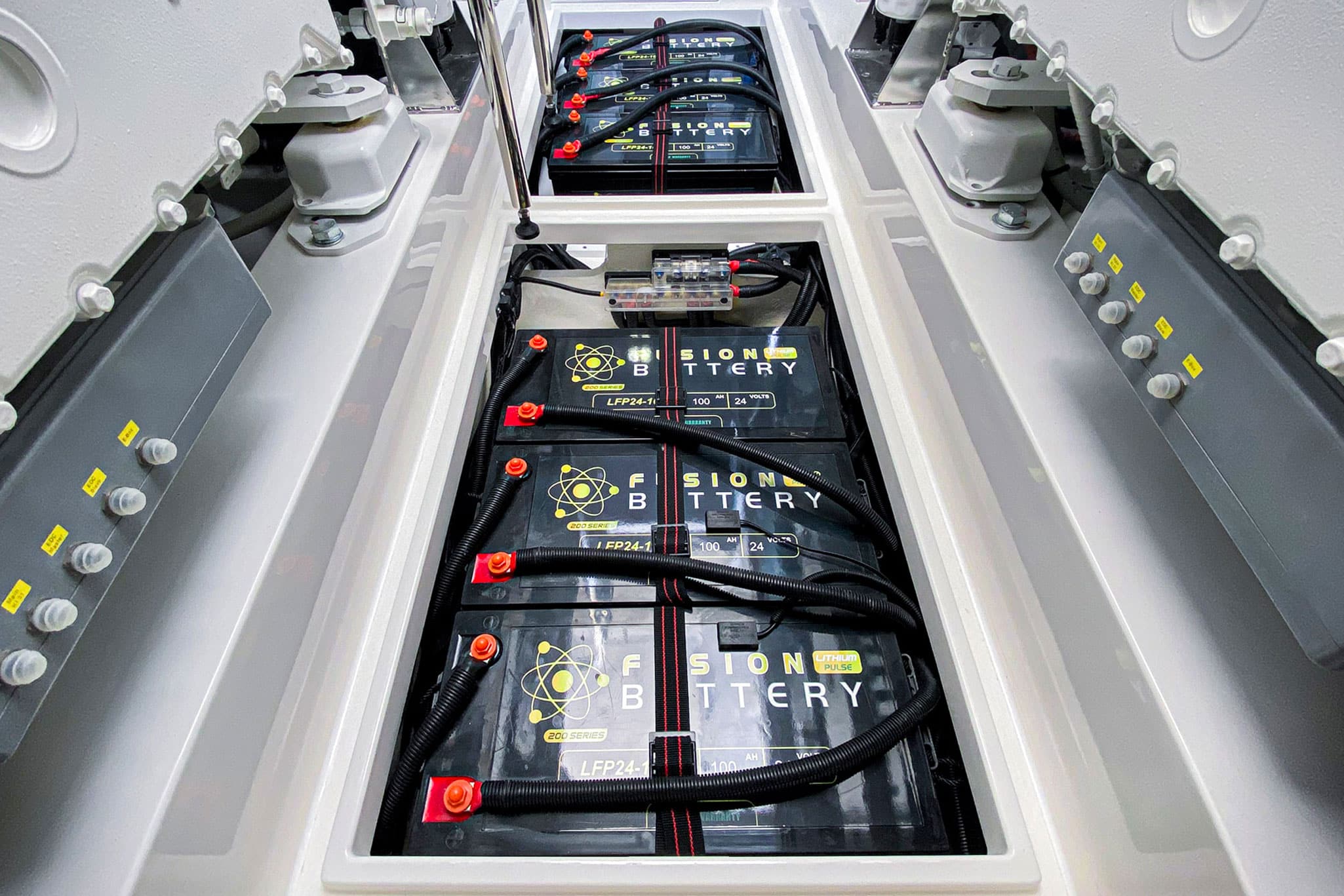
Lithium batteries (specifically LiFePO4, or lithium iron phosphate) weigh roughly one-third of what comparable AGM batteries weigh. A typical 100Ah AGM battery weighs around 65 pounds. A 100Ah lithium battery weighs about 30 pounds. On a vessel with a large house bank of say eight batteries, you're looking at a difference of 280 pounds. That's not just a number on a spec sheet. That's weight that affects performance, fuel efficiency, and trim.
For performance boats and sailing yachts where weight is critical, the savings alone can justify the switch. For larger motor yachts, the weight savings matter less, but they still add up.
Usable Capacity and Cycle Life
Here's where lithium really pulls ahead. AGM batteries should not be discharged below 50% if you want them to last. That means a 100Ah AGM battery gives you about 50Ah of usable capacity. Lithium batteries can be safely discharged to 80% or even 90% depth of discharge, meaning that same 100Ah battery gives you 80 to 90Ah of usable power.
In real terms, you need fewer lithium batteries to get the same usable capacity. And the cycle life is dramatically different. A quality AGM battery might give you 300 to 500 cycles before it starts degrading. A quality lithium battery can deliver 2,000 to 5,000 cycles. Over the life of the battery bank, lithium costs less per cycle even though the upfront cost is higher.
Charging Speed
Lithium batteries accept charge much faster than AGM. An AGM battery is limited by its internal resistance. It can only absorb so much current, and as it fills up, the charge rate drops off significantly. Lithium batteries can accept high charge current almost all the way to full, which means your alternator, solar panels, and shore power charger can top up the bank in a fraction of the time.
For cruisers who rely on solar or run generators for short periods, this is a major advantage. You can run the generator for an hour and put meaningful energy back into the bank, rather than running it for four hours to slowly top off AGMs.
The ABYC E-13 Standard
This is the part most installers skip, and it's the part that matters most for safety. ABYC (American Boat and Yacht Council) published Standard E-13 specifically for lithium battery installations on marine vessels. It covers everything from battery enclosure requirements to overcurrent protection, emergency disconnects, and thermal management.
Key requirements include: batteries must be securely mounted to prevent movement in heavy seas, the installation must include a Battery Management System (BMS) that protects against overcharge, over-discharge, and over-temperature, and there must be a means to disconnect the battery bank in an emergency. The BMS must also meet specific testing requirements to ensure it can handle the fault currents involved.
If your installer isn't talking about ABYC E-13 compliance, that's a red flag. A lithium installation that doesn't meet this standard is a fire risk and may not be insurable.
The Real Cost
A quality 100Ah LiFePO4 battery costs between $800 and $1,200, depending on the brand and features. A comparable AGM costs $250 to $400. So yes, the upfront cost is roughly 3x. But when you factor in the longer cycle life, the reduced number of batteries needed for the same usable capacity, and the reduced weight and charging time, the total cost of ownership over 5 to 10 years favors lithium significantly.
You also need to factor in the cost of a compatible charger, a BMS (if not integrated into the battery), and possibly upgrading your alternator or adding a DC-DC charger. A proper lithium conversion isn't just swapping batteries. It's a system upgrade.
Is It Worth It?
Lithium makes sense if:
You cruise frequently and rely on your house bank, you want faster charging from solar or generator, weight matters for performance, or you plan to keep the boat for years and want the lowest total cost of ownership.
AGM may be fine if:
You mostly day-trip with shore power at the dock, your power demands are modest, or you're working with a tight budget and the upfront cost of a full lithium system doesn't make sense yet.
The Bottom Line
Lithium isn't a drop-in replacement for AGM. It's a system upgrade that requires proper planning, ABYC-compliant installation, and the right supporting components. Done right, it's one of the best upgrades you can make to your vessel's electrical system. Done wrong, it's a safety hazard.
If you're considering a lithium upgrade, give us a call. We'll assess your current system, talk through your power needs, and give you an honest recommendation, whether that's a full lithium conversion or a targeted upgrade that makes sense for how you actually use your boat.
Questions about your vessel's electronics?
Our team is on the dock and ready to help. Call us or schedule a free vessel consultation today.